Showing posts with label JC Nigado. Show all posts

Wednesday, June 3, 2015

Ako Si Ninoy (Director's Treatment)

Director’s Treatment
                                                                                                           
AKO SI NINOY
(A MUSICAL ON THE LIFE AND ETERNAL TIMES OF BENIGNO AQUINO, JR.)

Written and directed by Vince Tañada


Cinema completes the continuum -- from the page to the stage and to the screen, where images are more or less immortalized in various forms.
            As a young student growing under the shadow cast by the larger-than-life image of Ninoy Aquino, I was wont to giving praise, fascinated by the facts and fiction of the man who would have been president that never was. Instead, his surviving wife and orphaned son became presidents whose respective terms were marked by military (Cory’s) and “civil” (Noynoy’s) coups d'etat.
            The play Ako si Ninoy (2009) was a commissioned work that I gladly and quickly embraced until its entire run. However, the film based on the same material is of my own volition. In a sense, it’s my way of disabusing the mind from a kind of hero-worship that has been overtaken by events, as it were.
            It’s a curious awakening about heroes and heroism that could be commuted to the Filipino Everyman, after all. The film depicts, in a slice-of-life fashion, the lives of 11 characters as they reflect or represent, individually or otherwise, the Ninoy in everyone. In other words, there’s a Ninoy or a hero waiting to happen in all of us.
            As a film, such is not an original concept though, having derived the idea in part from Mike de Leon’s Bayaning 3rd World (1999). De Leon’s film posits the theme of “kanya-kanyang Rizal,” in the same manner that Ako si Ninoy themes with “kanya-kanyang Ninoy.”
            The play resounded as a musical, so there’s no reason that its musical film version can’t. (It’s about time, one might say, considering the history and dismal performance of movie musicals in the country since time immemorial.) Such syllogism is, of course, inaccurate, as various factors come into play, particularly in the marketing and distribution of the film. But I remain undaunted.
            While it’s true that our company, the Philippine Stagers Foundation (PSF), has almost perfected the marketing of theater or live performances, knowing our demographics and the nature of native circumstances, I realize that selling films is an entirely different ballgame. As writer, director, producer and actor in both disciplines, I indeed wear several hats of familiar or strange sizes and shapes.
            The scope of a musical film usually mixes style and challenges genre boundaries, yet I prefer not to fall into a pastiche. The many but distinct characters of Ako si Ninoy have a solid unifying center in (Ninoy’s) heroism and kindred spirit. 
Pushing the limits shall enhance the film’s epic spectacle, and varied locations in different places/regions must be engaged for each of the 11 major cast surrounding Ninoy and Cory. The music by Pipo Cifra (of UST and ABS-CBN) is all original, studied and composed, hewing closely to the text of the musical material. Ako si Ninoy is not strictly a period piece; the production’s design showcases what’s casual and customary at present, juxtaposed with Ninoy and Cory’s not-so-distant time. And the cinematography breezes the scenes bright and lovely in most parts.  
            To portray Ninoy, Jericho Rosales (or Dennis Trillo) is apt for the role that demands top acting with good singing ability to boot. Cory’s role has been settled, if unanimously, in favor of Heart Evangelista, who fortunately belongs to the same pedigreed class.
            The rest of the cast shall be performed mostly by the Stagers, the PSF’s pool of talents, long in the wings to be discovered by mainstream entertainment. I also dream of casting about for James Reid and Nadine Ilustre, or their equivalents, in significant juvenile roles.
            As president, artistic director and main marketing man, I manage and direct the full operations of PSF from dawn to dusk to dawn, in a manner of speaking. But cinema offers an entirely different challenge, really a world apart from theater, although I’m not exactly a stranger to it. (I’ve done and dealt in two films, 2013’s Otso and 2014’s Esoterika Maynila, both directed by Elwood Perez.) The film arena is more complex, and in perilous times, but definitely more widely engaging and interesting, despite ,or because of, its current video and digital format.
            With the most successful theater company in the country behind me, I look at filmmaking as the next sphere of endeavor to explore. The field may be crowded and madding, but I believe there’s always room for a new seed to grow and bear fruit.
            Up until now no feature film on Ninoy Aquino -- or a similar film feature on Cory, for that matter -- has fired the imagination of filmmakers enough to put it on the big screen. Except for some documentaries, the definitive Ninoy or Cory film is yet to come.
To a certain extent, Ako si Ninoy serves as a fitting finale to a presidency and administration that have been straddling between the question of and the answer to heroes. Either way, let history judge the good or evil that men (and women) do, to paraphrase the Bard. Time and the memories of mice and men, with due apologies to John Steinbeck, shall be the final arbiter to scare or beat the living daylights out of so-called heroes or heels in any nation’s life.
Finally, Ako si Ninoy proposes a timely interpretation, an oblique view to the fabled life and politics of Ninoy through dance and song.


SPJCN Budget: Ph 15M

Ako Si Ninoy (Synopsis)

Synopsis
                                               
AKO SI NINOY
(A MUSICAL ON THE LIFE AND ETERNAL TIMES OF BENIGNO AQUINO, JR.)

Written and directed by Vince Tañada


Forget subdued. Ako si Ninoy is a film spectacle that traces the lives of  11 individuals in contemporary Philippines, and how they relate to the public persona and private character of the late modern-day hero, Benigno “Ninoy” Aquino, Jr., which resonate in our national life.
An overseas Filipino worker (OFW), a housewife, a teacher, a journalist, a labor leader, an activist, a doctor, a student, a teen star, a war veteran and a child hero: Their parallel lives, single and collective, and told in episodic style, are reflected on the screen, as they weave a tapestry of entwining stories that bear the stuff of heroism and what eventually makes a hero in everyone, just like Ninoy, the guiding thread of the film.
But heroes need not be dead.
            Freely inspired by Mike de Leon’s Bayaning 3rd World (1999), this film biography is adapted from Vince Tañada’s multi-awarded play of the same title, which suggests the Ninoy Aquino in every Filipino. A breakthrough in Philippine theater, the same play hit the boards, successfully touring the country with almost 500 performances in 2009 and 2010, to coincide with the campaign and election of Benigno “Noynoy” Simeon Aquino III for the presidency in May 2010.
            The biography’s narrative is character-driven, redolent of current issues and historical reflections, and the plot, such as it is, simply drifts in sequencing the formation of the whole film structure.
            In the end, our individual take on Ninoy’s heroism defines our own living heroism, as we struggle, survive and prevail.


SPJCN Budget: Ph15M

Sunday, November 16, 2014

‘EKSTRA’: SIMPLY SPECIAL, SIMPLY BEAUTIFUL

3/4 November 2014


‘EKSTRA’: SIMPLY SPECIAL, SIMPLY BEAUTIFUL
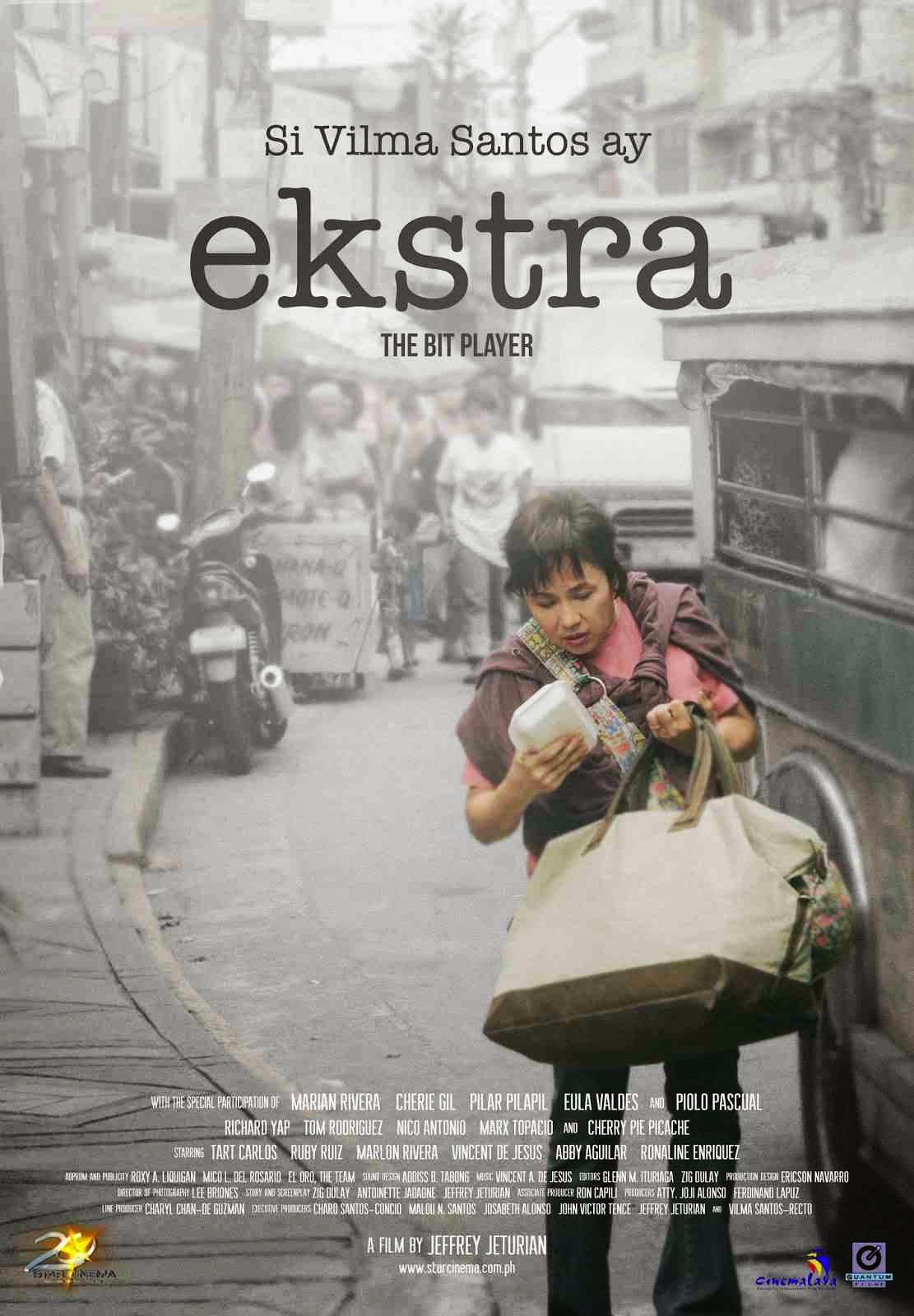
A film review by JC Nigado

Movie poster at Cinemalaya 2013
JEFFREY Jeturian is a prime storyteller whose film language is direct, unpretentious, almost unaffected.  From his first film, Sana Pag-ibig Na, to Pila-Balde to Kubrador to Ekstra and to many others in between, Jeturian’s straightforward style of filmmaking has always served him well, both in terms of craft and commerce.  Indeed, among the current crop of filmmakers he is the closest thing to Lino Brocka, not only in temperament but also in his mastery of the art and business of cinema, minus the obvious “politics” of it. Like Brocka, Jeturian is a disciplined actor’s director who always elicits the dramatic truth from his performers, and thus effects their best performances.
            In his latest film, Ekstra, one of the two best films of 2013 (the other is Lav Diaz’s Norte: Hangganan ng Kasaysayan), Jeturian has further distilled his “minimalist” approach to its basic essentials, making his work look simple and yet, simply special and beautiful. The Cinemalaya blurb was accurate when it described Jeturian’s entry as a “socio-realist” film, but, unfortunately, only a few seemed to have pursued the film’s course and defined its broad and deep meaning.
            Ekstra is David waiting to be discovered again. It is apparently small and easy enough to be viewed in one comfortable sitting, but big enough to encompass a sense of life as struggle of survival.  To date, the first Vilma Santos so-called indie has reportedly grossed close to 40-million pesos, probably the first of its kind in this day of digital movies.  It’s no mean feat, but small wonder, because the film features the biggest and most enduring star-actress in the history of Philippine show business.
            At any rate, mentioning Diaz here is deliberate because his Norte runs along parallel lines with Ekstra, especially in their characters’ naked guts and will to survive.  Besides, both Ekstra and Norte lend themselves well to interpretation and different readings, as the two films are translated from their respective literary sources.
            If anything, Fyodor Dostoevsky’s Crime and Punishment (1866) is widely acknowledged as the basis for Diaz’s Norte. However, that’s acknowledging only half the story or half the film (Sid Lucero’s main protagonist); the other equally important half (Archie Alemania’s other principal character) is inspired by another Russian classic, a contemporary novel, in Alexander Sotzhenitsyn’s One Day in the Life of Ivan Denisovich (1963). Both Denisovich and Alemania’s character in Norte are unjustly incarcerated, and, while inside, they acquire an inner dignity as they find some meaning out of their desperate and degrading existence, transcending their environment with an intense spiritual awareness, despite the growing dehumanization of prisoners.
            Like Solzhenitsyn’s One DayEkstra, unbeknownst to its writers (Zig Dulay, Antoinette Jadaone and Jeturian), is also rooted in the similar literary tradition of real-time narrative that happens in a day. Ekstra’s Loida Malabanan (judiciously portrayed by a plumpish Vilma Santos with striking sensitivity) hews closely to the character Guinevere Pettigrew in Winifred Watson’s 1938 novel, Miss Pettigrew Lives for a Day, an almost forgotten enchanting tale that unfolds over the 24 hours in the life of a neglected spinster.
            Malabanan and Pettigrew belong to the underclass, the underprivileged that are often irregularly employed or out of work.  Theirs are the stories of people who cope in the little ways they know how, keeping occupied with the mundane and absurd details of daily life, as they eke out a living, to make ends meet. Despite provenance and distant time, the novel and the film mirror each other, as they remind us that it is never too late to have a second chance, and that there’s always hope to go on living.
            There are other literary gems, which are also set in one day, and each uses and follows the same time-span to explore the vagaries and temporality of life, or lives as the case may be.  Like Ekstra, these novels deal with the tensions of everyday economics and practical philosophies that engage the otherwise ordinary people.  There are no grand schemes and evils here, only simple pathos and the careless indignities of everyday life – sans frills, fusses or any gimmicks.
            Anyway, Jeturian and his co-writers may not be aware that they have touched common ground with the works of certain literary greats, and their film “adaptation” posing as “original screenplay,” as it navigates life from dawn to dusk to dawn.  Among the select, are James Joyce’s Ulysses (1922), Virginia Woolf’s The Waves (1931) and Saul Bellow’s Seize the Day (1952) – all presaging Ekstra by, pun unintended, a long shot.  Still, Jeturian’s film neatly, if humbly, reflects the said novels’ eloquent textual and textural one-day structure and plot development.
            Memory always serves well those who remember the exquisite relatedness of the various and diverse arts, especially the closeness and incestuous relationship of literature and film.  With such an illustrious “kin” for background, Ekstra can’t afford to remain the “poor relation” that it is perceived to be. Alas, the enclosed social world of Jane Austen’s Pride and Prejudice of the early 19th century persists to this day and has transmogrified into a social bubble inhabited by cabal critics and bigots.
            But the fact that the movie is set mainly in tabloid TV, what with its dumbing soap-opera mindset and sensationalist mentality, somehow elevates Jeturian’s filmic discourse to the level of postmodernist culture and socio-economic politics.
            The film’s pervading theme of hope and survival is rendered powerless in a laissez-faire economy where commercial and fierce private interests rule. Jeturian deftly demonstrates the doctrine of individualism as personified by his sole principal protagonist, an everyday Filipino and a single parent, who faces the world and raises her collegiate daughter alone.  Maybe, it’s on purpose that there’s  hardly any mention of an absent husband or father throughout the film – it is not clear whether Malabanan was abandoned, separated, or the one who left her man in the movie. In addition, it translates well into the bigger picture that presupposes the absence of an authority figure that works for, and with, his people in a public trust. The true somebody who is looked up to and can be depended upon, in times good and bad.
            In a country with no one man or woman enough to lead it to people’s right progress and development, Ekstra fits the bill, as it were, tagging one and all the price we have to pay for bad government and public indifference.  Even God is silent, the film takes it for granted, and does not interfere in human affairs. Here, Big Brother brooks the form of an unseen force in the globalization enterprise of unrestricted corporate interests, where big business on a binge everywhere are buying and consuming us, as they practically take over and run our lives. 
Nationwide release poster
            The genius of taping a TV drama about the exploited sugar workers in a retrogressive feudal system within the film puts the ekstra character as sakada worker in “double jeopardy.” The extra in the movie is an additional role portraying another additional role of a sakada in the teleserye being shot. The sense of dramatic irony in the interweaving double fiction is exaggerated by the fact that it impinges on our own social and economic reality.
            Vilma Santos’s Loida Malabanan embodies the common Filipino worker, the overworked but underpaid all-around laborer who assumes various roles at multi-tasking. She then grabs every opportunity that is presented to her, unmindful of the required ability, skill or the appropriate equipment for the task, in order to earn more money for the long hours of toil, with no overtime pay. As such, Malabanan represents the majority of Filipinos who live in slum conditions, virtually imprisoned in abject poverty from womb to tomb, as they say.
            It is to Jeturian’s credit that, expectedly or unexpectedly, he refuses not to treat poverty as pornography. His “cinematic” slum area is not the usual squalid squatter colony that shows curios or “exotic” destinations before the world.
            Instead, he explores the microcosm of society (symbolized by TV) that has been reduced to mindless entertainment, as he exposes the systemic disease and disrepair of the general establishment (represented by the oppressive system and debauched working conditions).
            The film brilliantly ends at the same place, where it began, signifying a continuing daily cycle of quiet, bittersweet surrender that, unlike Ivan Denisovich’s single day in a decade’s prison term, could even last Loida Malabanan’s lifetime. Under the circumstances, redemption, or what passes for it, comes by embracing fate with profound resignation.
            Be that as it may, the ultimate defining scene where Santos, sensible and knowing, calmly gazes at the busy TV screen says it all: another day begins in repeat, as the world of corrupt culture and grasping politics turns.

JULIO CINCO NIGADO
Tagurabong City, Philippines, 2014


Wednesday, August 7, 2013

THE OXFAM AMBASSADOR BALANCES HER ACT IN AN ADVOCACY FILM


26 July 2013


CHERRY PIE PICACHE
THE OXFAM AMBASSADOR BALANCES HER ACT IN AN ADVOCACY FILM
By JC Nigado


CHERRY Pie Picache dreams of a world without poverty and where people don’t go hungry. Judging from history, it’s an impossible dream, but she can dream, can’t she? Just like acting in an “aged” advocacy film (produced in 2008 and shown sporadically since, in different venues), where she does and doesn’t deliver the message as we know it.
        Towards this end, the 43-year-old actress advocate uses her celebrity by joining Oxfam, “an international confederation of 17 organizations networked together in more than 94 countries, as part of a global movement for change, to build a future free from the injustice of poverty.” As for the ancient advocacy film, we’ll tackle it later, much like its delayed mainstream cinema screenings.
        History tells us that “Oxfam comes from the Oxford Committee for Famine and Relief, founded in Great Britain in 1942. Initially, “the group campaigned for food supplies to be sent through an allied naval blockade to starving women and children in enemy-occupied Greece during the Second World War.” (What about in today’s bankrupt Greece?)
        Since then, Oxfam has grown and become a world leader in the delivery of emergency relief. In the Philippines, its impact has been greatly felt in disaster-stricken areas including those ravaged by typhoons Sendong, Ondoy, Pablo and many others.
        As Oxfam Ambassador, Picache took the “GROW Challenge” to “Reduce Food Waste,” particularly in the Philippines. Early in July, Oxfam held a promotional program at the Trinoma Activity Center in North EDSA, Quezon City to introduce the so-called Grow Challenge.
       Along with Picache, the other Oxfam celebrity ambassadors are Mikael Daez (“Eat Brown Rice”), Tuesday Vargas (“Save Water”), entrepreneur Stephanie Zubiri (“Buy Local”) and Erwan Heussaff (“Conserve Energy”).
        “I chose Oxfam for my advocacy, “ declares Picache, “because I believe in its objectives, and what it has done for the poor and the dispossesed (e.g. land-grabbing victims) not only in our country but also worldwide. As Oxfam Ambassador, I want to focus on the campaign to reduce food waste in several levels – from product harvest to the table. It’s my way of giving back, of contributing something to the world whenever and wherever I can.
       For starters, the multi-awarded actress cites a 2008 survey of the Food and Nutrition Research Institute (FNRI) that revealed the food-wasting habits of Filipinos. Do you know, she asks, that every Filipino wastes about three tablespoons of rice every day?
        According to the Oxfam handouts distributed at the Trinoma affair, cumulatively, “this translates to 308,000 tons of rice valued at US $535,000 (P23,005,000) every day or at least $223 million (P9.58 billion) a year. And such an amount could have fed about 4.3 million poor and hungry Filipinos.
        On a worldwide scale, the International Fund for Agricultural Development (IFAD) recently reported that one in seven people are starving. On the other hand, the United Nations Food and Agriculture Organization (UNFAO) said that, at present, more than one billion people are going hungry and that more than 20,000 children below five years old die daily from hunger.
       As far as some people know, the private Picache is also active in her varied concerns for women prisoners at the Correctional Institution in Mandaluyong City and other inmates at the Nationa Bilibid Prison, through the intercession of certain civic and religious volunteers.
       As an actress, Picache also lends major support to an an advocacy film against child abuse – Ellen Ongkeko-Marfil’s Boses, which opens nationwide in select SM cinemas on July 31, 2013. Like poverty, child abuse is another form of injustice and violence that diminishes all of us.
        In Boses, the popular Picache delineates a self-effacing character of a social worker, in stark contrast to her eminent award-winning performances in films and on TV. The subtle shift is quite obvious, in the same manner that, at the moment, the busy actress has opted to focus on her advocacies, for a change, and to free herself, albeit temporarily, from her gruelling regular TV work.  
        These days, whether in indie films or other forums, Cherry Pie Picache makes it a point that her passion and whatever she believes in are always current in her work.
         Move over Vanessa Redgrave, Melina Mercouri, Simone Signoret, Brigitte Bardot, Jane Fonda, Angelina Jolie et al, the Filipino actress advocate is here to stay – Chin Chin Gutierrez, Alicia Mayer, Jaclyn Jose and, of course, Cherry Pie Picache, to name a few.